
Student Storage Services
Complete Guides
Company & News
Shipping to College
College Storage for Parents
College Move-In & Move-Out
College Packing List
Dorm Storage & Organization
College Summer Storage
Dorm Room Essentials
Sports
Personal
Lifestyle
College Life
Health and Wellness
Entreprenership
Food
Business
Storage Solutions for Students Transferring Colleges
Bottom line: Transfer students get better storage deals than summer movers because you're booking during off-peak periods when facilities compete for business, but you need different location and timing strategies since you're coordinating between two schools instead of one predictable move-out date.
Transferring colleges puts you in a completely different situation than students following the standard academic calendar. Your move-out date doesn't align with the massive May exodus, and your new school's move-in might happen weeks or months later.
The timing difference creates both challenges and advantages. You'll need storage for an unpredictable length of time, and you might be coordinating between schools in different states. But you're also booking during periods when storage facilities are hungry for business and willing to negotiate.
Why Off-Peak Timing Works in Your Favor
While summer storage follows predictable May-to-August cycles, your transfer might happen in January, March, or October. That timing difference shapes everything about your storage strategy.
During peak May move-out season, a 5x10 storage unit near campus typically runs $120-180 per month. Book that same unit in February or October and you'll pay $80-120, plus facilities often throw in perks like free moving truck use or waived security deposits.
The promotional access difference is significant. Many storage companies run "First Month Free" promotions year-round, but they're usually sold out by April near college campuses. Book in January for a March transfer and you'll likely snag that deal.
You're also not competing with hundreds of classmates for the same pickup slots during finals week. This gives you flexibility to choose convenient times and negotiate better terms.

Book 3-4 Weeks Before You Move Out
Students who hit this timeline consistently get better-located, better-priced units than those scrambling in their final week. Here's what that timeline looks like:
- Week 1: Research facilities within 10 miles of current campus, compare rates, read reviews
- Week 2: Call 3-4 facilities directly (don't just book online), negotiate terms, ask about transfer student discounts
- Week 3: Book your unit, coordinate pickup logistics, arrange moving supplies
- Week 4: Execute move-out, with buffer time for unexpected issues
Your transfer acceptance timeline affects everything. If you know you're transferring by early November for a January start, you have weeks to plan. If you get accepted two weeks before you need to move, your options narrow quickly.
Start researching storage options as soon as you submit transfer applications, not after acceptance letters arrive.
Call Instead of Booking Online
Transfer students moving outside peak season can often negotiate directly with facility managers for better terms than posted online rates. Explain that you're transferring and ask if any promotions apply. Students regularly talk their way into 10-15% discounts this way.
Location Strategy for Single vs. Long-Distance Transfers
Choosing storage location for transfers requires different thinking than summer storage. Summer students typically store near their current campus and retrieve everything in August. Transfer students need to consider proximity to both schools.
If you're transferring within the same region (like from Boston University to Northeastern), store near your current campus for easy move-out, then plan retrieval logistics for later.
For long-distance transfers, run the math on three scenarios:
- Store locally + ship later: Often cheapest for small loads (under 10 boxes)
- Store locally + road trip retrieval: Best for medium loads if you have reliable transportation
- Professional moving services: Worth the premium for large loads or cross-country moves
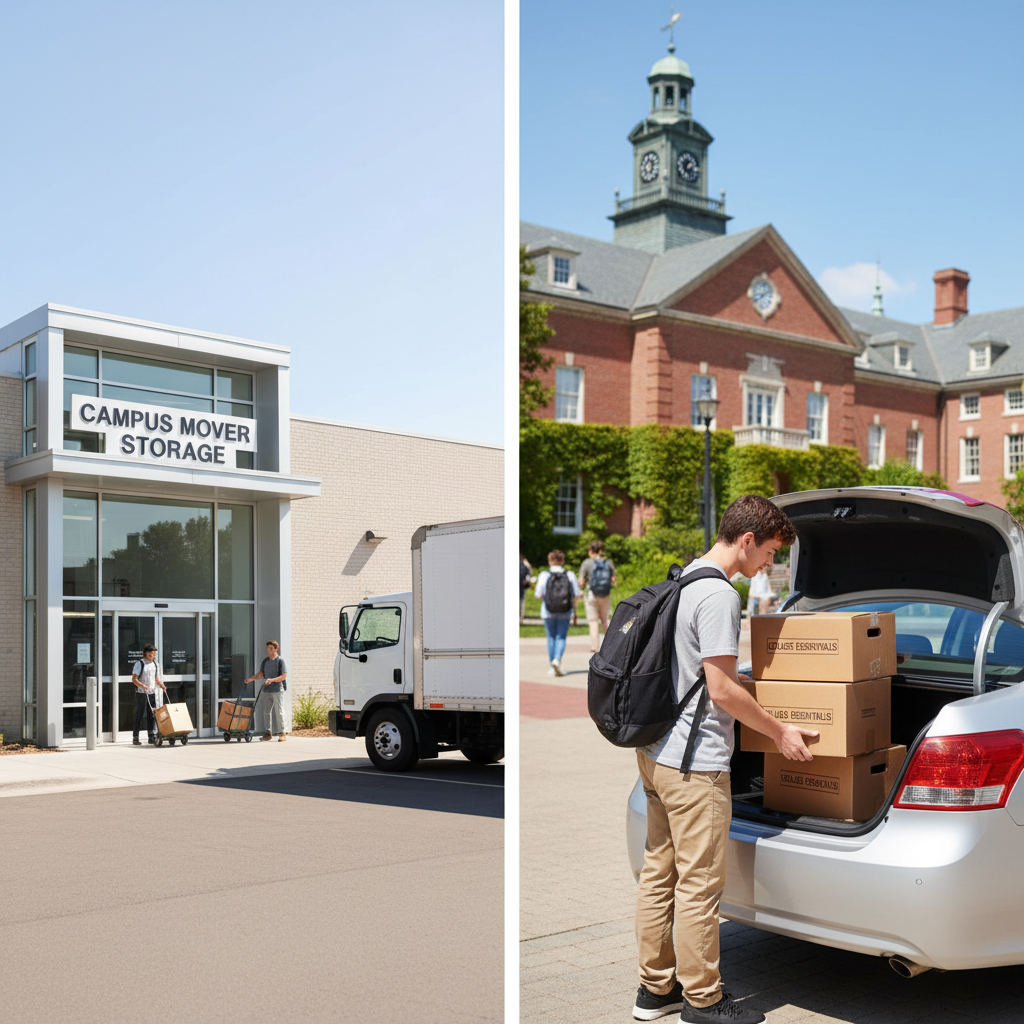
Real example: A student transferring from University of Texas at Austin to Northwestern in Chicago found that storing locally in Austin for $95/month and driving back to retrieve belongings cost $340 total (3 months storage + gas). Professional shipping through a student moving service cost $520 but saved two days of driving and hotel costs.
Managing Costs During Off-Peak Periods
Storage costs for transfer students typically run 25-40% lower than peak season rates. A 5x10 unit that costs $160/month in May might run $100-120 during off-peak months.
Here's how to maximize those cost advantages:
- Negotiate package deals: Ask about discounts for paying multiple months upfront
- Right-size your unit: Most students overestimate space needs by one size level
- Consider climate vs. non-climate controlled: Save $30-50/month if your belongings can handle temperature fluctuations
The climate control decision matters more for longer storage periods. If you're storing belongings for 6+ months and have electronics or wooden furniture, the extra cost usually pays off. For short 2-3 month transfers during mild weather, standard units work fine.
Insurance for Cross-State Storage
Your renters insurance from your current school might not cover belongings stored in a different state. Check coverage terms before moving, and consider whether the storage facility's insurance makes sense for your situation.
Pack Smart for Partial Access
Unlike summer storage where you retrieve everything at once, you might need to access certain items during your storage period. Pack a "first access" box with items you might need early: official documents, unseasonable clothing, or electronics you couldn't fit in your immediate move.
Label boxes with both contents and priority levels:
- Priority 1: Items you definitely need at your new school
- Priority 2: Items you probably want
- Priority 3: Items you're unsure about
This makes retrieval decisions easier when you're settling into your new school and figuring out what fits in your new dorm setup.
Coordinate Timing Between Schools
Some schools have strict move-out deadlines with daily fines for late departures. Others are more flexible. Know exactly when you must be out of current housing and when you can earliest move into new housing.
Build buffer time for unexpected housing assignment delays or transfer credit issues that might affect your start date. The logistics of transferring are unpredictable enough without cutting your storage timing too close.
Related reading
- College Summer Storage: The Complete Guide for Students
- Shipping to College and No Car Solutions: The Complete Guide to Getting Your Stuff to Campus
- Dorm Storage and Organization: The Complete Guide to Making Your Tiny Room Work
Storage Scholars supports moves beyond the standard same-school summer cycle. A transferring student can have Storage Scholars pick up and store their boxes over the summer, then ship everything to their new school, though the company notes that in this scenario it can only ship boxes rather than move furniture. Students who are graduating or relocating long distance can request a personalized quote for separate long-distance moving, and the company's Moving After College page is built specifically around the first post-graduation move.
Storage Scholars offers three pre-determined storage terms, a Summer Term of up to 120 days, a Short Term of up to 30 days, and an Abroad Term of up to 270 days, and will hold items month-to-month for students studying abroad. Custom storage terms are accommodated but these three common terms are marketed and pre-priced on the online customer portal.
Frequently Asked Questions
How far in advance should I book storage when transferring colleges?
Book your storage 3-4 weeks before you need to move out of your current school. This timeline gives you access to better-located units, promotional deals, and flexible pickup scheduling. Students who wait until their final week typically face limited options and higher prices, even during off-peak transfer periods.
Should I store my belongings near my current school or my new school?
Choose based on total transportation costs and retrieval convenience. Storing near your current campus simplifies initial pickup but requires later shipping to your new school. Storing near your destination campus solves delivery problems but complicates move-out. Calculate gas, truck rentals, and facility rates to determine which location saves money overall.
What size storage unit do transfer students typically need?
Most transfer students fit their essential belongings in a 5x5 unit, roughly the size of a large closet. This accommodates typical dorm contents including bedding, clothes, desk supplies, a mini-fridge, and boxed items. Only rent larger units if you're storing furniture that won't fit in your new housing arrangement.
Can I save money by sharing a storage unit with another transfer student?
Yes, sharing cuts costs by 40-50%. Instead of two separate 5x5 units at $50 each, split one 5x10 unit at $75 total. That's $37.50 per person instead of $50. Use transfer student social media groups or your destination school's networks to find reliable storage partners heading to the same campus.
Set a reminder to sign up for storage!
We’ll remind you to sign up when it gets closer to your winter and summer break!
This article is part of our College Summer Storage guide

Other Articles
Want to hear from us about exclusive discounts and promotions?
Drop your email and we'll keep you up to date!
