
Complete Guides
Company & News
Shipping to College
College Storage for Parents
College Move-In & Move-Out
College Packing List
Dorm Storage & Organization
College Summer Storage
Dorm Room Essentials
Sports
Personal
Lifestyle
College Life
Health and Wellness
Entreprenership
Food
Business
How Much Square Footage Do You Need for Your College Apartment?

Finding the right apartment size feels like solving a puzzle, especially when you’re juggling a tight budget with your actual living needs. Whether you’re moving out of the dorms for the first time, splitting costs with roommates, or planning ahead for post-graduation life, knowing how much space you actually need can save you hundreds of dollars and a lot of stress.
Bottom line: Most college students need between 400-800 square feet depending on whether they’re living alone or with roommates, but your lifestyle and budget matter more than hitting a specific number.
The key isn’t finding the “perfect” amount of space but rather understanding what factors actually impact your comfort and happiness in a rental. Let’s break down everything you need to consider when apartment hunting so you can make a confident decision.
What factors should you consider when choosing apartment size?
Your ideal square footage depends on several personal factors that go way beyond just counting bedrooms. Start by thinking about your current living situation and what’s working or not working about it.
Budget constraints shape everything. Rent typically increases with square footage, but the relationship isn’t always linear. Sometimes a one-bedroom apartment costs only slightly more than a studio but gives you significantly more usable space. Factor in utilities too since heating and cooling larger spaces costs more.
Your daily routine matters more than you think. If you’re constantly on campus, at work, or hanging out elsewhere, you might be perfectly happy in a smaller space. But if you love cooking elaborate meals, hosting game nights, or need a quiet study space, prioritize those areas over total square footage.
Pro tip: Measure your current furniture before apartment hunting. A queen bed needs about 70 square feet of floor space, while a full-size couch typically requires around 35 square feet.
Living arrangements change the equation completely. Sharing space with roommates means you need adequate private areas for everyone, but you can split the cost of common areas. Living with a partner might mean you need less individual space but more shared storage.
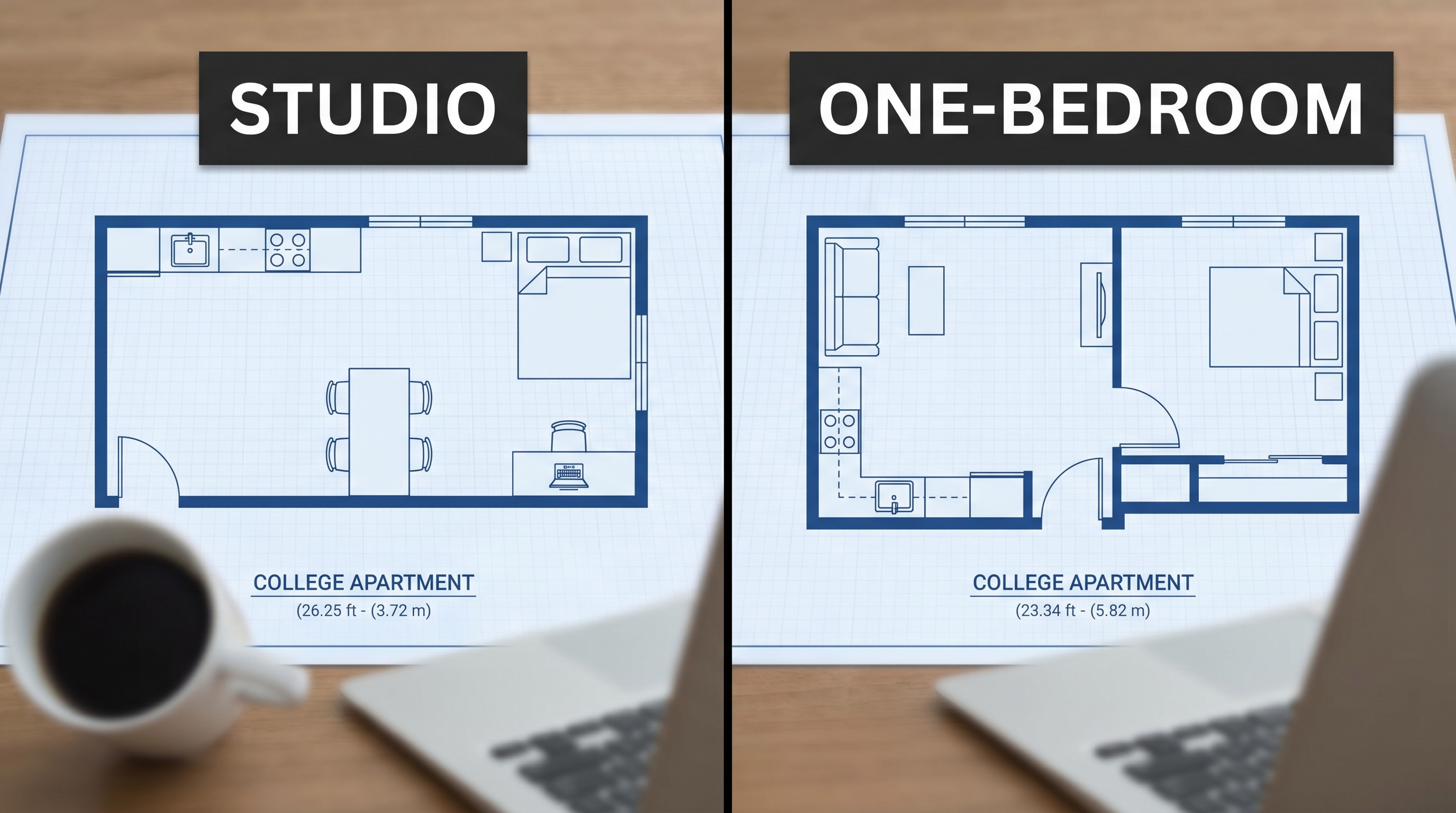
How much space do different apartment types offer?
Understanding standard apartment sizes helps you set realistic expectations and compare options effectively. When evaluating your housing options, it’s helpful to understand the differences between townhouses, condos, and apartments to determine which property type best fits your needs. Here’s what you can typically expect from each apartment type.
Studio apartments range from 300-600 square feet and work best for individuals or couples who don’t mind sharing all their living space. You’ll have one main room that serves as bedroom, living room, and sometimes dining area, plus a separate bathroom and usually a small kitchen or kitchenette.
One-bedroom apartments typically offer 500-1,000 square feet with a separate bedroom, living area, kitchen, and bathroom. This extra privacy makes a huge difference for couples or anyone who wants to separate their sleeping space from their social areas.
Two-bedroom apartments usually provide 800-1,200 square feet and work well for roommates, small families, or anyone needing a home office. You’ll often get multiple bathrooms and more storage space throughout.
Studio
Square Footage: 300-600 sq ft
Best For: Singles, couples on budget
Monthly Rent Range: $800-1,500
1-Bedroom
Square Footage: 500-1,000 sq ft
Best For: Singles, couples
Monthly Rent Range: $1,200-2,200
2-Bedroom
Square Footage: 800-1,200 sq ft
Best For: Roommates, small families
Monthly Rent Range: $1,800-3,500
Three-bedroom apartments start around 1,200 square feet and are ideal for multiple roommates or families. These often come as townhomes or duplexes with multiple levels and several bathrooms.
How do you calculate your actual space needs?
Rather than guessing, you can estimate your space requirements by breaking down how you actually use different areas. This approach helps you avoid paying for space you won’t use or cramming into something too small.
Start with your non-negotiables. List the furniture and belongings you absolutely need to bring. Measure larger pieces like beds, desks, and sofas. Add up the floor space these items require, then multiply by 1.5 to account for walking space and room to move around comfortably.
Consider your lifestyle priorities. If you cook regularly, factor in counter space and room to move around the kitchen. If you work from home, you’ll need a dedicated workspace that doesn’t double as your dining table. If you exercise at home, account for space to roll out a yoga mat or set up equipment.
Smart strategy: Use your current living space as a baseline. If your dorm room feels cramped at 200 square feet, aim for at least 400-500 square feet in an apartment. If you’re comfortable in a 300-square-foot space, you might be fine with a studio.
Factor in storage realistically. College life comes with seasonal items, textbooks, sports equipment, and clothes for different weather. If your apartment lacks adequate closet space, you might need extra square footage for storage solutions or consider professional storage services during summer breaks and semester transitions.
Think about guests and social life. If you frequently have friends over or family visits, you’ll want space for people to hang out comfortably. A small apartment can work if you mainly socialize outside your home, but if you love hosting, prioritize common areas over bedroom size.
What are the pros and cons of different apartment sizes?
Each apartment size comes with distinct advantages and trade-offs that affect both your daily life and your budget. Understanding these helps you make a decision you’ll be happy with long-term. If you’re considering purchasing rather than renting, it’s worth exploring the key advantages and risks of buying a condo to see if ownership aligns with your financial goals.
Smaller apartments (300-600 sq ft) keep costs low and force you to stay organized, but they can feel cramped when you’re spending more time at home. They’re perfect for minimalists or anyone who’s rarely home, but challenging if you have lots of belongings or need quiet study space.
Medium apartments (600-1,000 sq ft) offer the best balance for most college students and young professionals. You get separate spaces for different activities without paying for rooms you won’t use. The main downside is that rent increases significantly compared to studios.
Larger apartments (1,000+ sq ft) provide plenty of space for roommates, home offices, or entertaining, but utilities and rent can strain a student budget. They’re ideal if you’re splitting costs with multiple people or have specific space requirements for hobbies or work.

The key is matching your apartment size to your actual lifestyle rather than what you think you should want. A cozy 500-square-foot one-bedroom might make you happier than a sprawling 1,200-square-foot place that eats up your entire budget and leaves you house-poor. When weighing your options, consider whether renting an apartment versus buying a condo or townhouse makes more sense for your current life stage and financial situation.
Remember that your needs will likely change as you progress through college and into your career. Starting with a smaller, affordable place gives you flexibility to upgrade later when your income grows. If you’re thinking long-term about homeownership, understanding the financial implications of condo ownership can help you plan your housing trajectory more effectively. Many college students find that using professional moving and storage services during semester breaks allows them to live comfortably in smaller spaces without feeling cramped by seasonal belongings and extra items.
Frequently Asked Questions
How many square feet does a 2-bedroom apartment typically have?
A 2-bedroom apartment typically ranges from 800-1,200 square feet. This size provides enough space for roommates or small families, usually including multiple bathrooms and adequate storage throughout. The exact square footage can vary significantly based on location, building age, and layout efficiency.
What is a good apartment size for a single person?
For a single person, 400-600 square feet is typically sufficient. This could be a studio apartment (300-600 sq ft) or a one-bedroom apartment (500-1,000 sq ft). The choice depends on your budget, lifestyle, and whether you need separate spaces for sleeping, working, and entertaining.
How much space do I need per person in an apartment?
A general rule is 200-400 square feet per person, but this varies based on relationships and lifestyle needs. Couples can share space more efficiently than roommates, while people working from home or with extensive belongings may need more space. Consider your furniture, storage needs, and daily routines when calculating space requirements.
Should I choose a studio or 1-bedroom apartment?
Choose a studio (300-600 sq ft) if you're on a tight budget and don't mind open living space. Opt for a 1-bedroom (500-1,000 sq ft) if you want privacy between sleeping and living areas, work from home, or frequently have guests. The cost difference is often smaller than the space benefit you receive.
Set a reminder to sign up for storage!
We’ll remind you to sign up when it gets closer to your winter and summer break!
This article is part of our College Move-In & Move-Out guide

Want to hear from us about exclusive discounts and promotions?
Drop your email and we'll keep you up to date!
