
Student Storage Services
Complete Guides
Company & News
Shipping to College
College Storage for Parents
College Move-In & Move-Out
College Packing List
Dorm Storage & Organization
College Summer Storage
Dorm Room Essentials
Sports
Personal
Lifestyle
College Life
Health and Wellness
Entreprenership
Food
Business
Winter Break Storage Options for College Students
Bottom line: Winter break storage is a short-term headache that hits international students and anyone stuck with mandatory dorm closures hardest. The key is starting early enough to avoid paying premium rates for oversized units during finals week.
Most college storage advice focuses on summer moves when millions of students compete for the same units. Winter break storage serves a much smaller population, but the timeline is brutal. You're looking at 3-4 weeks instead of 3-4 months, often with mandatory dorm closure dates that aren't negotiable.
If your dorm kicks you out December 15th and you can't haul your mini-fridge back home, you need a solution that makes financial sense for such a short stint. The good news? You're not competing with 40,000 other students. The challenge is avoiding the monthly storage rates that apply whether you need 20 days or 30.
Who Gets Hit with Winter Break Storage Requirements
International students represent the biggest group needing winter storage. If you're from anywhere requiring a $1,000+ round-trip flight, going home for three weeks makes zero financial sense. You need somewhere to store your stuff while you stay with friends, travel, or find temporary housing.
Mandatory dorm closures create the most urgent storage needs. Schools like Harvard, Yale, and Middlebury shut down residence halls completely during winter break. Check your housing contract for closure dates. Harvard gives students exactly 24 hours after their last final to clear out completely.
Study abroad students face the worst scenario. If you're moving out in December but won't return until May, your "winter break storage" becomes a 5-6 month commitment with completely different cost calculations.
Housing transitions also drive storage needs. You might be switching dorms, moving off-campus with a lease that doesn't start until January 15th, or dealing with Greek housing that closes for holidays.
When to Book and What Timeline Actually Works
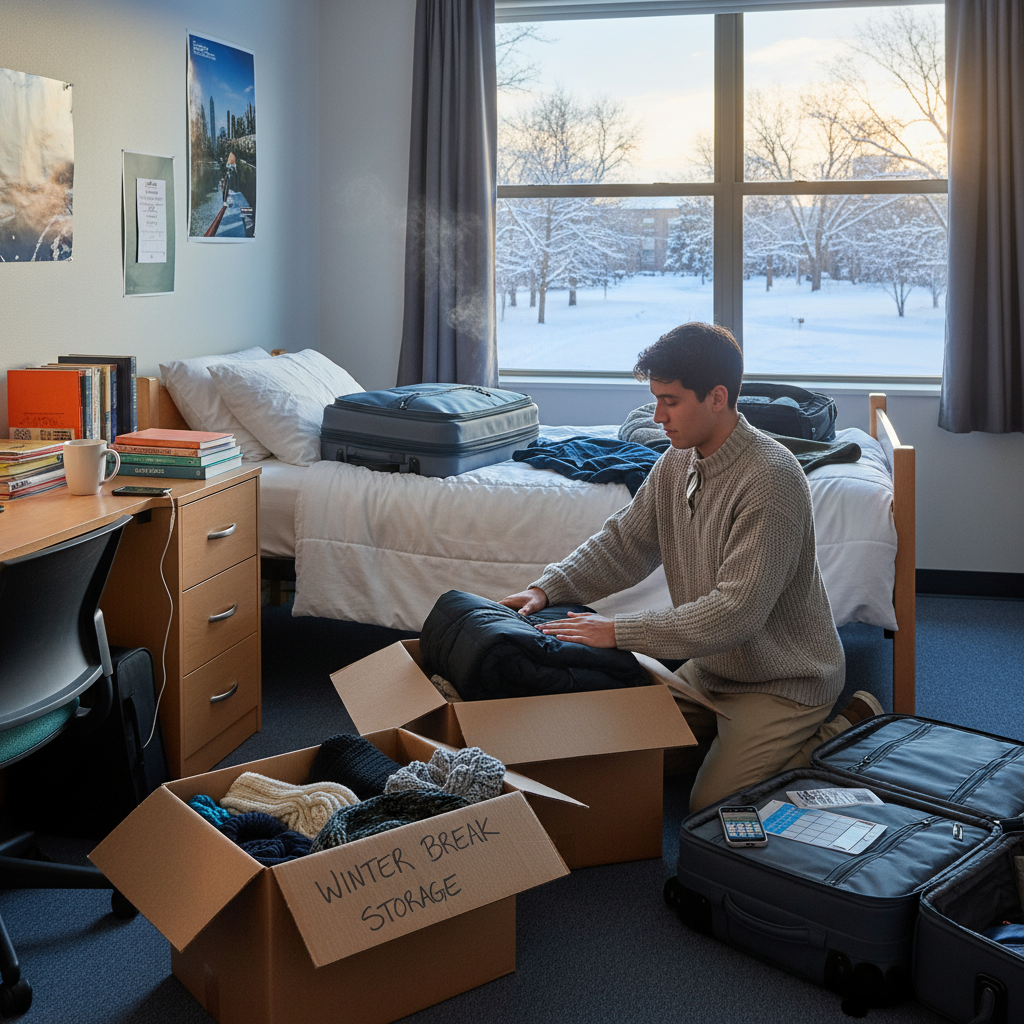
Most universities close dorms between December 15-20 and reopen January 10-15. Start researching by December 1st. This feels early but avoids the finals week scramble when you should be studying, not calling storage facilities.
Climate-controlled units near campus still disappear first, but you're not competing with summer's massive demand. Students who wait until the last week face familiar problems: the right-sized units are gone, leaving you with oversized 10x10 spaces when you needed a 5x5.
Book before December 10th if your dorm closes mid-month. Many storage facilities offer discounted winter rates to fill capacity during their slow season. Public Storage locations near campuses might drop standard rates from $89/month to $65-70 in winter. Always ask about seasonal promotions.
Work backward from your move-out deadline and plan your storage trip for the weekend before finals, not during. The worst scenario is hauling your microwave to storage the night before your calculus final.
Cost Realities and Smarter Alternatives
Here's the frustrating reality: monthly rates apply even when you only need three weeks. A $75/month storage unit costs the same whether you use it for 30 days or 20 days. This makes alternative solutions suddenly attractive.
Traditional self-storage runs $50-120/month for small units near college campuses. Extra Space Storage, Life Storage, and Public Storage dominate college towns, with 5x5 units typically costing $60-90/month. Add $15-25 for climate control if you're storing electronics.
Peer-to-peer storage apps like Neighbor often beat traditional facilities on price and convenience. Neighbor connects you with locals renting garage space for $30-60/month. Some hosts offer winter break specials specifically for college students.
Factor in transportation costs when comparing options. If the cheapest storage unit is 15 miles from campus and you don't have a car, your rideshare costs might make a pricier but closer option the smarter choice.
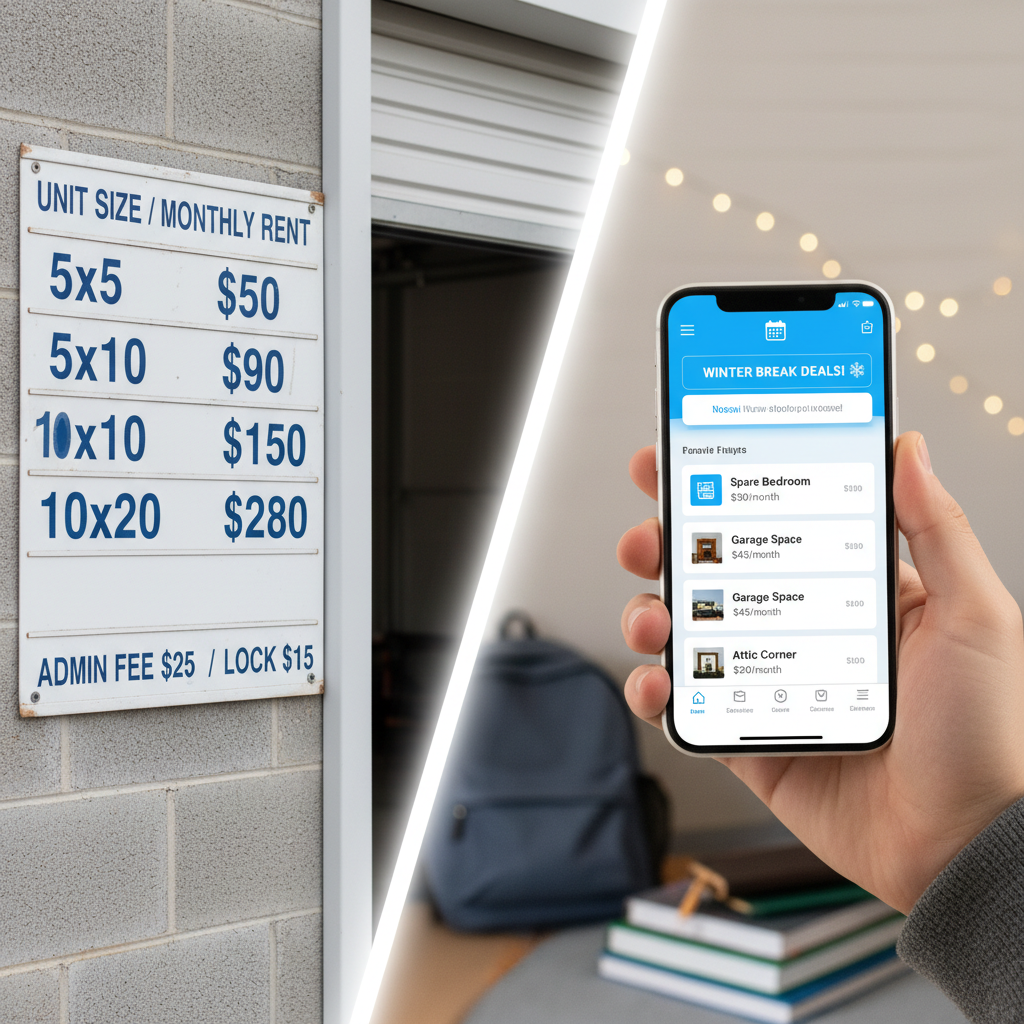
Pod-based solutions like PODS work well when shared with roommates. A ReloCube costs around $200/month but easily holds 2-3 dorm rooms worth of stuff. Split three ways, you're looking at $65 per person for premium convenience.
Some students get creative with shipping solutions. If you're from California studying at NYU, shipping two large boxes home via FedEx Ground might cost $150-200 total, which competes with New York City storage rates and offers much more convenience.
Group Storage Strategies
Coordinate with other students to rent one larger unit and split costs. A 10x10 unit costing $120/month becomes $30 per student when split four ways. Use moving blankets to separate belongings and establish clear pickup responsibilities.
University Resources and Creative Solutions
Before paying for commercial storage, check what your university offers. Many schools provide limited winter break storage in basements or auxiliary buildings for $25-50 for the entire break. These spots fill up fast and have size restrictions, but the savings are substantial.
Academic departments sometimes allow students to store items in offices or lab spaces, especially if you work as a research assistant. This works best for small, valuable items rather than furniture.
Local student networks often provide the best solution. Students going home might have basement space, garage access, or extra room in off-campus apartments. Offering $50 plus dinner when you return is often cheaper and more reliable than commercial options.
For broader college storage strategies throughout the year, our complete guide to college summer storage covers long-term planning approaches that can inform your winter decisions.
Emergency Options When You're Out of Time
If you're reading this with days before dorm closure, don't panic. You still have options, just fewer good ones.
UPS Stores and FedEx locations near campuses sometimes work with college students for temporary box storage, especially during winter break when business is slow. Call and explain your situation.
Extended stay hotels might offer luggage storage for a reasonable fee, especially if you book a few nights to establish guest status. Winter break coincides with their slow season, making managers more flexible.
For students dealing with the broader challenge of organizing dorm spaces efficiently, our complete guide to dorm storage and organization offers strategies that can minimize what you need to store during breaks.
Airport storage lockers work for small, valuable items but cost $3-8 per day, making them expensive for full winter break storage. Only consider this for irreplaceable items you can't risk storing elsewhere.
Winter break storage doesn't have to derail your plans or drain your budget. Start early, explore creative alternatives with friends, and remember that this short-term hassle beats paying for an empty dorm room. For families navigating these decisions together, our college storage guide for parents provides additional perspective on managing student belongings throughout the school year.
Related reading
- College Summer Storage: The Complete Guide for Students
- Dorm Storage and Organization: The Complete Guide to Making Your Tiny Room Work
- College Storage for Parents: Everything You Need to Know About Managing Your Student's Stuff
Storage timing does not have to match the standard school calendar. Students can choose Summer storage (up to 120 days), Short Term storage (up to 30 days) for winter break or a quick gap, or Abroad storage (up to 270 days) for a semester overseas; after the initial 4-month minimum, abroad storage bills month-to-month until the student returns. These storage terms are most common for students and are advertised bundles students can select from; however, Storage Scholars offers custom storage terms if the student doesn't fall into the three common buckets. Storage Scholars also has complimentary moving dates timed to the start and end of each semester specifically to accommodate students leaving for or returning from study abroad.
Storage Scholars publishes a cost comparison showing its 2026 average rate of $172 per month against a total DIY cost of $3,684 or more once packing supplies, truck rentals, a self-storage unit, and incidental costs like flights and lost work time are added up.
Frequently Asked Questions
Is winter break storage cheaper than summer storage?
Winter break storage usually costs about the same monthly rate as summer, but you only pay for one month instead of three. A 5x5 unit runs $40-100 for the entire winter break period. Some facilities offer winter discounts during their slow season, so ask about promotional rates. The shorter duration makes the total cost lower, even if monthly rates stay consistent.
When should I book winter break storage?
Start looking in early December, about three to four weeks before your dorm closes. This gives you time to compare prices and secure a conveniently located unit. Unlike summer storage where booking months ahead matters, winter break doesn't see huge demand spikes. Just don't wait until the last week before closure when you're juggling finals and packing simultaneously.
Do international students need climate-controlled storage for winter break?
Climate control usually isn't necessary for winter storage unless you're keeping electronics or temperature-sensitive items. Your bedding, clothes, and dorm supplies survive fine in standard units during cold weather. If you're storing laptops, tablets, or other electronics, either keep them with you or pay the extra $15-30 monthly for climate control to prevent battery damage from freezing.
Can I split a storage unit with my roommate for winter break?
Splitting a 5x10 unit with your roommate cuts costs significantly. You each pay $30-50 instead of $60-100 for separate units. Make sure you trust the person and clearly divide the space inside the unit. Most facilities allow shared rentals as long as one person signs the lease and handles payment. Just coordinate who retrieves items first in January.
Set a reminder to sign up for storage!
We’ll remind you to sign up when it gets closer to your winter and summer break!
This article is part of our College Summer Storage guide

Want to hear from us about exclusive discounts and promotions?
Drop your email and we'll keep you up to date!
